People say I have ‘good genes’.
However, to maintain being fit and healthy you need more than just good genes. Granted, it helps along the way. And yes, of course some have to work harder than others to achieve similar goals – particularly those with disabilities or health conditions. But with or without ‘good genes’, all of us need to strain/exercise our bodies accordingly, to be fit and healthy. You don’t need good genes to do that.
It’s a load of bollocks to think that ‘good genes’ are enough to keep you physically and mentally fit without doing much else. Because they’re not. So regardless if you’re lucky or not to have good genes, it’s imperative to strain/exercise accordingly, in order to maintain health and wellness.
Use your body. Use the tools available to you. Or don’t. It’s a choice.
For those who tend to say “it’s alright for you, you have good genes”… ask yourself: ‘Am I exerting myself accordingly to achieve my own goals?’ (Be honest with yourself). I hazard to point out that you have the same human body as the person with good genes AND in most cases the same tools (ie a gym, a park) available to you.
[deep breath]
So just in case that wasn’t clear, when it comes to your health and fitness, and the way you look, it is down to more than just good genes. It’s how you physically strain your body and mentally exercise. I think consciousness, and faith, or in my case spiritually, has a great impact too – at least that’s what I believe.
Now, I’m not saying for one minute keeping on top of your health and fitness is easy – regardless of your natural disposition – because it’s not. But everything in life is hard in some way.
“Marriage is hard. Divorce is hard. Choose your hard.
Obesity is hard. Being fit is hard. Choose your hard.
Being in debt is hard. Being financially disciplined is hard. Choose your hard.
Communication is hard. Not communicating is hard. Choose your hard.
Life will never be easy. It will always be hard. But we can choose our hard.”
– Devon Brough (?)
Let me personally elaborate on that quote: running full pelt around a squash court for an hour is VERY tiring, weightlifting is HEAVY and puts you under a lot of tension, stretching sore muscles REALLY hurts, having a cold shower is pretty much UNBEARABLE, etc etc etc. But these hards inform the easiness of being able to function properly, move easier, and breathe cleaner because they promote stronger muscles, a more efficient cardiovascular system, a heightened immune system, higher lung capacity etc. Ultimately, the hard choices have a knock-on effect to the rest of my life, making it easier for me in so many other areas. It’s Not A Coincidence*.
On the flip side, eating ultra-processed ready-made food is easy to buy and consume, but it’s harder for your body to process compared to natural ingredients. UPF’s provide comparably much less nutrients than whole-food meals, which in turn makes functionality harder. Not exercising is easy to do – your body isn’t under any strain, you don’t ache or have to recover from anything, you have more time in the day to do what you want etc. – but not-exercising is ultimately very hard on your body because of the repercussions that it has as we go through life: faster ageing, obesity, diabetes, disease, inflammation, infection, weakness, etc (we could literally be here all day).
*the name of my future book… if I write one…
BUT… don’t panic if this is you! Initially it can be daunting or difficult getting going, but health and fitness really doesn’t have to be that way. There are lots of things we can do to make the hards easier.
And one massive thing that makes everything in life easier is… drum roll…
Habits.
Profound isn’t it?
No? … well it is, so shut it.
Seriously, dialling down on your habits is a game changer.
Think of habits like ingredients that make up a recipe. The better the ingredients, the better recipe you’re going to end up making. In our case, the better the habits, the more happy and healthy you are going to be. And I believe that building habits really is the easiest way to get the correct outcome when trying to achieve longevity.
Life can’t always be purely formulaic but its foundations can, at least that’s what I’ve found, along with quite a few others.
And that brings me on to James Clear.
Because like with Cold Exposure and Wim Hof, there is only one place to start with habits, and that is James Clear – epitomised by his book Atomic Habits.
Buy it now.
Immediately.
In fact, right this second.
Stop reading this and do it!!!!!
(… although I urge you to deal with the FOMO of what else I’ve written. You fucking Judas.)
Before you do leave me though, let me share some spoilers AKA my favourite 3 takeaways from Atomic Habits:
—
1. Identity-based habits vs Outcome-based habits

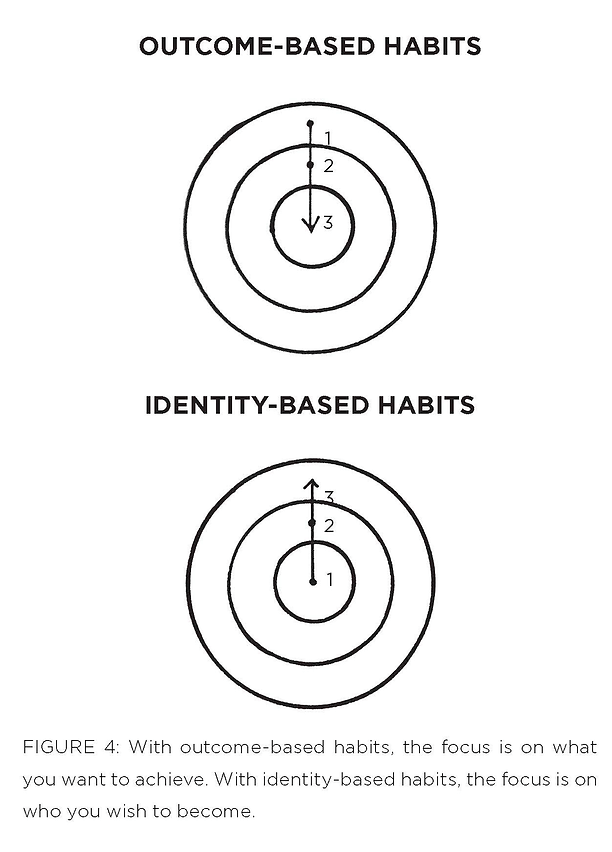
He discusses these via the ‘three layers of behaviour change’: outcomes, processes and identity.
As he explains, when people form habits they usually start with focusing on what they want to achieve (top right), leading to outcome-based habits.
However, as James writes: “The ultimate form of intrinsic motivation is when a habit becomes part of your identity. It’s one thing to say I’m the type of person who wants this. It’s something very different to say I’m the type of person who is this.”
He goes on: “The goal is not to read a book, the goal is to become a reader. The goal is not to run a marathon, the goal is to become a runner. The goal is not to learn an instrument, the goal is to become a musician.”
When I first stumbled upon this concept, it really resonated with me. And when I started implementing identity-based habits (bottom right) as opposed to outcome-based habits, this was a true turning point in making them consistent.
Be that person who does the thing. Don’t do the thing now and again and hope you’ll just become the person.
2. Habit-stacking
A simple concept but when outlined makes so much sense: do habits together, one after another, with new habits and existing habits. Big habits or small habits.
For example:
Big – Stretch > Exercise > Sauna. Small – get out of bed immediately when your alarm goes off > make your bed > clean your teeth + floss > shower > moisturise > brew a cup of tea > meditate whilst the tea is brewing > take your cup of tea and start the first task of the day. Or something like that.
The point is is that you can reinforce existing habits with other existing (or new) habits. And before you know it, you’ve already stacked lots of good habits with each other. Resulting in health and happiness!Unsurprisingly enough though, this also applies for Bad Habits, so be careful.
And whilst we’re on the subject of Ed Sheeran (no I’m not going to quote the song), there’s a great clip of him on a radio show online talking about how his habits lead to other things:
“If I have one beer, then I’m going to want another beer, and then I’m going to want a shot, and then I might want a cigarette, and then I might want a Big Mac… but with healthy shit, it’s if I drink water all day long it makes me feel great, and then if I feel great I might exercise, and if I exercise and feel great I’ll have a good night’s sleep, and if I have a good night’s sleep I’m more likely to want to get up early in the morning and do it all over again.”
Forget the song lyrics Ed, I think they could be the most profound words you’ve said or written.
3. Habit-tracking
Habit tracking changed my life, in an amazing way. I started doing it during my Dad’s health decline when I was spending a lot of time at home, when trying to maintain a routine of some sort, and adjusting to the change of location, access to the gym and various other factors. It helped me gain and maintain a very good degree of health/fitness and massively helped my emotional capability.
Habit-tracking holds you accountable because it’s literally in black and white (pending what colour pen you use, you child) as to what habits you’ve completed. It’s direct evidence of progress. It’s also a reward system because, let me tell you, it’s VERY satisfying when you build up a series of ticks consecutively! (Yes, this is genuinely what excites me nowadays.)
Here’s a previous photograph of a habit-tracking month gone by:
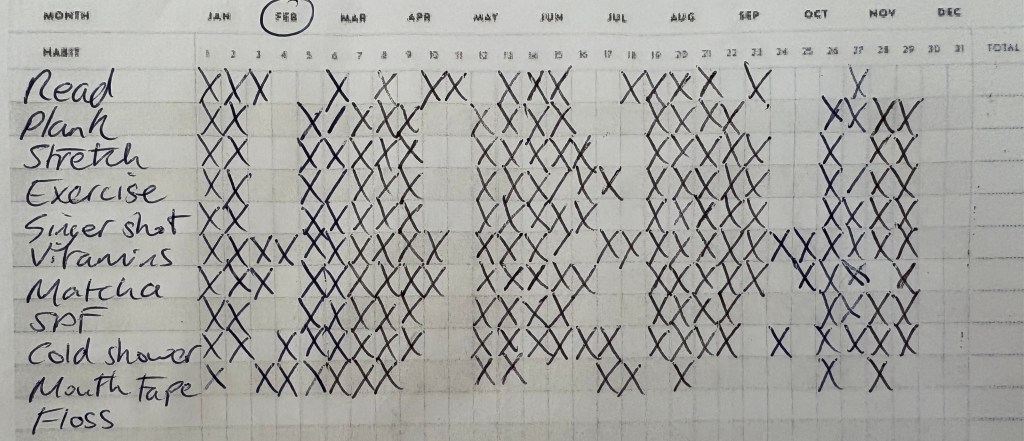
The eagle-eyed of you I’m sure have discovered that I have 0 motivation or discipline with flossing, and as a result, I couldn’t even manage 1 attempt this particular month… we’re all human.
Apart from that, it’s a very decent month I’d say.
‘Not breaking the chain’ is a great and very rewarding process that James talks about, as is the power of ‘never having 2 consecutive days off’.
Although admittedly I struggle with the latter at weekends…
—
SO if any of those 3 bits of information resonate with you like they did for me, I urge you to buy a copy and read Atomic Habits by James Clear. An excellent book and one that will give you 100000% (not accurate, but not far off) ROI.
Whilst writing this blog post, I stumbled upon this unpublished update report on my own habits (another sentence I never thought I’d write), found in the notes on my phone:
“So, 5 months after writing down (with a pen and paper, not a phone) my personal and professional short/medium/long-term goals and 3-4 months of habit tracking, I feel great physically and mentally great. Strong, but I prefer great. I’m happy. Despite grief, I really believe healthy habits and lifestyle choices can be a catalyst in helping to making you physically and mentally strong and healthy, which is directly linked to being happy in life.”
For me, this is [at the very least my own personal] proof of how habit-tracking can hold you accountable, massively help in maintaining discipline and motivation, but most importantly spawn those amazing results.
I won’t dwell on the grief part of that note – but I think it’s really helpful context for how I can still feel that good, if I habit-track, despite the shittiness of experiencing grieving.
—
CONFESSION…. !
I hold my hand up, I’m a total fucking hypocrite, because I don’t habit track at the moment. Maybe in future again though… BUT… I did it for quite a few years.
IMMEDIATE VALIDATION EXPLANATION: I haven’t habit-tracked for a good few months, the reason being – and I promise I’m not a hop off-on bandwagon guy – is that I feel as though the habits I used to track/stack are very well engrained into my routine and psyche these days, meaning I do most of them daily anyway. So although I’m not manually recording results, I still feel as though I am achieving maintaining habits. And I also wear a WHOOP now, so I pretty much track everything digitally. I use a custom plan where I have added my ‘behaviours’, and closely follow my logs of sleep, strain and recovery.
Wait a minute…
Am I still habit-tracking? Just in a different way?
…
Is my WHOOP in fact a glorified habit-tracker?
[REALISATION WHEN WRITING THIS]
UPDATED CONFESSION:
Despite not using pen and paper to track my habits, I still do habit-track. And I find a great tool to do this is WHOOP.
Side note: it’s been a game changer for my sleep. Categorically helping me to focus on and improve my restorative sleep levels. For more on sleep visit HERE.
—
I urge you to start forming habits. New ones around good existing ones, maybe lose one or two bad ones if you can, replace existing bad with good etc etc etc.
You might be thinking: Why though?
Fair point.
Results is why. Progress is why. Improvement is why.
Health is why. Happiness is why.
Back to Habits King James Clear one more time:
“Habits are the compound interest of self-improvement. The same way that money multiplies through compound interest, the effects of your habits multiply as you repeat them. They seem to make little difference on any given day and yet the impact they deliver over the months and years can be enormous. It is only when looking back two, five or perhaps ten years later that the value of good habits and the cost of bad ones becomes strikingly apparent.”
I think that’s the best thing to keep in mind about starting/maintaining habits – the bigger picture. And with consistency, results will happen. Guaranteed. Like actually guaranteed. And results will most likely be much quicker than 2 years. With wellness we’re talking weeks, even days. Just hold up your end of the bargain, and habits will get you results.
Hence, the pattern of my habits is always directly correlated to how I’m feeling at the time too – as in, the more habits I do, the better I feel. The healthier I am, the happier I am. Physically better, mentally better – in all aspects, there’s no catch. That’s because It’s Not A Coincidence*.
*the name of my future book, did I tell you?
Another great way of managing habits is via time-blocking. Literally blocking out windows of time, for different tasks, for various durations, throughout the day.
By no means essential but actually very useful. Especially if you have a freelance/not-consistent work calendar or non-typical routine, as in my case. I find it also helps with motivation, a LOT. And boring tasks. A LOT.
There’s one method which is 25 minute deep work/5 minute break – called The Pomodoro Technique – and I find this extremely effective. It’s enough time to get stuck into something, but short enough so that you don’t risk zoning out or wanting a break. I’m talking deep work. Deeeeeeeeep wooooooooork. No phones.
Wait what?
Yeah NO PHONES.
[Audible gasp from the young crowd]
Now if you’re Gen-Z DON’T PANIC. Life will (miraculously) go on. You will survive. And if you fall into this particular demographic (or hold similar traits), and NEED your actual phone to do actual work constantly for 25 minutes, get a separate work phone, or… a new job?Or failing that, GET A FUCKING LIFE?
Any other generation reading this though, The Pomodoro Technique (without phones) can be very effective.
As the psychiatrist Phil Stutz says, if you focus on your ‘Lifeforce’ – which is your Body, Relationships and Yourself – then every other thing you would love to have in your life will follow. And I believe prioritising habits can help you do that.
If you are reading this and are conscious that you want to improve your habits, or even just start doing some, because you want to be healthier and/or happier, I urge you to get start prioritising/forming them as soon as tomorrow.
It can be daunting starting a new routine and implementing new things, granted, but habits will hold you accountable and help you get there. Try it!
And before you know it… your body is in a better place, your mind is in a better place, and you feel better – scratch that, you’re healthier and happier. To be honest, that’s kind of how it happens. If you’re committed and follow through. Before you know it, everything gets easier. Generally. …Well, it doesn’t, but you get stronger. Try it. Especially in the tough times – despite my affair with hypocrisy during this post, I can at least vouch for that.
To quote our new friend Phil Stutz one more time, “there are 3 guarantees in life: pain, uncertainty, and constant work”. And surprise! Habits help navigate these entirely.
It’s Not A Coincidence*
*Still a name for my future book… although I can’t promise it will be as good as James Clear’s books or Ed Sheeran’s lyrics…
—
Written as part of The Wishing Wellness – visit HERE for more content on habits.
 The Wishing Wellness