DO NOT: CTRL-ALT-DEPLETE (The Happy Chemicals)!

I felt like I had a mental breakthrough when I first starting learning about neuroscience and the brain… wow, that sounds fucking lame doesn’t it? 

But I actually did. Like almost an epiphany, when realising that the chemicals in our brain *directly and non-coincidentally* affect us depending on their presence. Like why we may feel euphoric at times, or the opposite when we’re depleted and down in the dumps. This is largely down to those chemicals in our brains/bodies.

Personally I find neuroscience fascinating. And I’ve barely scratched the surface.

But I think true value and perspective can be found through basic awareness of these chemicals – and when I say basic, it’s because for a neuroscientist, this chapter is probably about the difficulty equivalent of a child’s Mickey Mouse colouring book. But if like me, you don’t know much but want to know more, hopefully this is a good place to start.

Firstly, there are sooooo many different types of chemicals in our bodies – and the following information was written to bring an awareness solely to the ones that contribute to making us HAPPY – because that’s the business The Wishing Wellness is in, health and happiness! Yay, happiness for everyone! 

So, in short, Neurotransmitters and Hormones are your body’s chemical messengers. They carry messages from one nerve cell across a space to the next nerve, muscle or gland cell. Pretty bloody important messages I might add. Messages that keep us moving, feeling, eating, stretching, breathing, living, and masturbating.

These little messages affect how you feel about EVERY THING – your mood, motivation, willingness, understanding. Basically ALL behaviours and attitudes. How can I say this better? THE MESSAGES CONTROL EVERY FUCKING THING IMAGINABLE. THEY CONTROL YOUR LIFE. 

And there are SO many messages. Like shit tonnes (not accurate). 

For context, waaaaaaaay more than what poured down Harry Potter’s chimney chute on Privet Drive. Like waaaaaay more. Let’s say 500000 billion trillion more messages than that (again, not accurate). So you better believe there IS post on Sundays.

Now if it still isn’t clear that there are an UNIMAGINABLE amount of these things, you’ll need more than a trip to Hogwarts to fix that understanding.

But you get the point, there’s are lots of messages. And by messages, I mean neurotransmitters and hormones. 

So we know that trillions of these little chemical messages get sent around our body to keep us living. 

But HOW do the chemical messages get sent, I hear you ask (in an extremely polite and curious manner)?

Well, (glad you asked)… when our cells receive new information – information that we need to action, it is received by our brain cell’s neurons, which create an electrical impulse that triggers the release of neurotransmitters. And in the brain cells, neurotransmitters get escorted via tiny little bubble-like compartments, known as vesicles, where they travel to the edge of the cell, and wait to be released. 

‘Vesicles’ are the things that hold together different kinds of neurotransmitters. And each vesicle can contains THOUSANDS of neurotransmitter molecules. When it’s time to be released, the vesicles fuse with the neuron’s membrane (kind of like a skin, which separates the cell’s content and the outside of the cell) and they dump their contents into the gap between other cells, which is called the synapse (the synapse is the area where two cells come close enough together, to be able to transfer chemical signals from one cell to another). The gap itself is called the ‘synaptic cleft’, which is around 40 nanometres wide. And just to put the size of this gap into perspective, a human hair is 75,000 nanometres wide. Mental. Literally.

Once in the synaptic cleft (the tiny gap), the neurotransmitter molecules then interact with receptors on the neighbouring neuron membrane, causing an action in that cell as a result. For those (lazy-ass) little neurotransmitter molecules that get stuck in the synaptic cleft and become unused, they do one of three things: disappear or drift away in a process called diffusion; go back to the original neuron via ‘reuptake’; or get devoured by demonic enzymes, where component parts of the neurotransmitters then get sent back to the original neuron. More on that another time. We’re staying in Mickey Mouse territory, remember.

So the amount of messages/transmissions/Harry Potter Hogwarts invite letters is CRAZY. Genuinely incomprehensible.

Because the SCALE of this operation is incomprehensible – as each neuron has anywhere between a few to HUNDREDS OF THOUSANDS of synaptic connections, and these connections can be with itself, neighboring neurons, or neurons in other regions of the brain. I’ll say it again – mental. Literally. So every millisecond of every day, there is an INCOMPREHENSIBLE string of events occuring in the brain: where billions of neurons transmit signals to each other at TRILLIONS of synapses. 

… Maybe then, the human body is the best definition of ‘organised chaos’, ever? 

However, IF this process breaks down and neurotransmitter release fails, we begin to run into some problems.

Many brain disorders and nervous system diseases, including autism, schizophrenia, Alzheimer’s disease, epilepsy, and even certain kinds of bodily poisoning, have been linked to problems at the synapse. This is why it’s SO important to maintain a healthy balanced lifestyle, which contribute to looking after these processes… 

That’s kind of vague, granted, but just have a quick Google as to how we can maintain a healthy level of synaptic transmission, if you want more on that part. 

You fucking (admirable) nerd.

SO… onto happiness! Yay! And all the other great things that our neurotransmitters help with.

There are too many types of neurotransmitters and hormones to discuss entirely, so I’m going to focus on some of the main ones – and the ones that you can manually influence to a large degree, in order to naturally increase your happiness. 

The three* ‘happy chemicals’ are: 

  1. Dopamine
  2. Serotonin
  3. Oxytocin

*(We’re also going to take a quick look at Endorphins, as they too are pretty bloody useful…)

1. Dopamine is technically a hormone, but functions as neurotransmitter. It acts as our ‘reward system’ – where we experience pleasure, motivation, learning, alertness, focus, and mood changes. This is naturally increased by: regular exercise (hence the ‘runners high – which is dopamine being released), socialising, meditation, random acts of kindness, having a nourishing diet (eating foods that contain tryptophan – the highest sources of which are from eggs, salmon, cheese, pineapple, tofu, nuts and seeds, and turkey), eating enough protein + healthy fats, meditation, yoga, massages, playing with a pet, walking in nature or reading a book, sex, focused work or fulfilling a task, cleaning or being productive, cold exposure, or having a phone detox. A lack of dopamine -which can happen if we go down the unnatural route too often – can lead to: addiction, obesity, ADHD, and more. Moderate accordingly!

2. Serotonin is technically a neurotransmitter. It promotes happiness, calmness, and regulates emotional stability.

It can be naturally increased by getting good regular sleep, (as it works with sleep/wake cycle), being outside – sunlight, exercising, eating healthy, calmness, meditation. A lack of serotonin can lead to a disconnect from human instinct, and ultimately depression. (This is why people who suffer from depression can be treated with medication such as Selective Serotonin Reuptake Inhibitors (SSRIs)).

3. Oxytocin is technically a hormone, although it functions as a neurotransmitter – and is known as the ‘love drug’ or ‘love hormone’.

It’s main function is actually to facilitate childbirth – fertility/maternal behaviour and lactations – it triggers labour, stimulates contractions, and regulation of lactation.

HOWEVER, we’re focusing on it as a hormone for it’s other reasons, which are: establishing and maintaining social bonding, sexual pleasure, anti-stress like reducing blood pressure and cortisol, promoting growth and healing, and cognitive function including memory.

Oxytocin and the stress hormone cortisol oppose each other, so it’s essentially impossible to be in a state of one when experiencing another. When was the last time you were stressed out of your mind whilst having sex?

A lack of Oxytocin can lead to poor communication, poor connection, irratibility, inability to feel affection, heightened anxiety + fears, lower sex drive, and lower empathy.

4. And finally… Endorphins. They are technically peptides, which are short chain of amino acids. Not one of the ‘happy chemicals’ per se, but I think important to be aware of either way. Endorphins when released block perception of or alleviate pain, increase feelings of wellbeing leading to lower stress, and they improve your mood. The body releases endorphins when you do pleasurable activities such as eating, exercise, have sex, or laugh.

A lack of endorphins can lead to a sedentary lifestyle, aches, pains, depression, mood swings, and addiction.

We can unnaturally increase all of our happy chemicals via: alcohol, drugs (and not just those deemed ‘bad’ – ie. caffeine), compulsive/risk-taking activities such as gambling, watching porn, or eating junk food. Sure we all have our vices, but moderate accordingly to maintain consistent health and happiness – I think following the 80/20 rule in life, generally, is a great method to being consistently healthy but also enjoying yourself along the way.

Now unfortunately I do have to circle back and triple-underline the dangers of always taking the easy option in releasing your brain chemicals unnaturally. And I really don’t want to sound like I’m a member of the fun-police here, but there is for sure a much more sinister side to ‘unnaturally increasing our happy chemicals’ than the majority of society (that does this) realise. 

This is where my GENIUS phrase of CTRL-ALT-DEPLETE comes in.

…(I know, GENIUS isn’t it!!!) 

(Really chuffed with that one)

Essentially the last thing you want to do, for sustainable health and happiness, is to be constantly depleting your brain chemicals via unnatural ways of increasing them. There has to be a balance. 

So let’s take Dopamine as the example, and a phrase you may have heard of is ‘Dopamine Depletion’. This is when there is a lack of dopamine available in the brain, which leads to a whole range of physical and mental issues if not balanced accordingly. As mentioned above, there are SO many things you can do to naturally balance your [dopamine] levels, but the problem we face in today’s world, is that there are SO many immediately accessible and unnatural ways to get a hit of [dopamine], literally at our fingertips. Hence why doom-scrollers are stuck in a daily perpetual loop of short-form videos, 99% of which likely have absolutely no value.

That means society as a whole is increasingly more and more using these unnatural methods to release these chemicals, way more frequently than ever before. It’s part of the reason why obesity is higher than ever, depression is higher than ever, divorce rates are higher than ever.

The government website published an Obesity report in May: “In 2023 to 2024, 64.5% of adults aged 18 years and over in England were estimated to be overweight or living with obesity. This is higher than 2022 to 2023 (64.0%) with an overall upward trend since 2015 to 2016 (61.2%).” Scary stuff! 

Let’s go online…

Scrolling TikTok for hours is one free dopamine hit after another, and if you don’t get that ‘reward’ (which is your brain releasing [dopamine]) from one video, you move on to the next within seconds, sometimes less than a second, and BAM! IN YOUR FACE there is that release again you’re so desperately looking for – whether it’s someone riding a unicycle using just their head or a dog making pancakes. Either way, this immediate and constant barrage of ‘pleasure’ via dopamine hits is not natural. (Contradiction: I could easily watch videos of dogs all day). 

Over time, this means it takes more and more of these amazing chemicals to get the same feeling(s) we once had with lower amounts of the same thing, and over time you will generally maintain lower levels than what you would have done if you were regulating them naturally. This can result in what initially seems to be small things but overtime can have a sinister effect on you and your life: little motivation to complete tasks or achieve goals, not feeling pleasure for things you once enjoyed, little energy, difficulty concentrating, sleep trouble, memory loss – and that’s not mentioning even worse things like depression and conditions like Parkinson’s disease (the list goes on).

And I think it’s really important to bring cavemen into this. (Didn’t expect that sentence did you).

Because as humans, we haven’t evolved fast enough to be able to deal with these new ways of processing information and reward-seeking behaviour. Technology is evolving exponentially faster than us and we don’t have the tools to balance everything accordingly with all of this information. A natural dopamine hit is what cavemen released when they successfully hunted down and ate food, and it is exactly that release, and subsequently that feeling, which promoted them to go and out and find more food the next time. I’m pretty sure if you drove the DeLorean back to those times and handed a cavemen a smartphone with Tik Tok, they’d probably starve to death. Because they would get that chemical release they so desperately seek over and over and over instantly, 1000 times a day, as opposed to minimal amounts a day after their hard-fought efforts to find that food. Albeit that release would feel no way near as good/be as high/natural as the one when successfully finding and eating food.

Now I don’t blame individuals nowadays for succumbing to these unnatural means of releasing [dopamine], it’s impossible not to get dragged into this way of living with the way of the world nowadays when we are FUCKING BOMBARDED by everything around us. Every single app is competing for our attention, trying to maximise the time we spend in their world – every food chain is filling their products with the tastiest (irrespective of health outcomes) additives to make us eat more – Big Pharma is giving us instant relief for various symptoms when the focus should be on treating the longer-term root cause of our issues, as opposed to it’s multiple symptoms (think of it like treating the branches of a tree instead of the roots) – the list goes on (again). 

So if I haven’t made it clear already – it’s SO important to regulate ourselves and our reward systems accordingly via promoting our brain chemicals naturally. That’s how we achieve consistent health and happiness throughout our lifespan, and stay away from adverse effects such as illness and addiction. Granted, I’m not saying our modern day addictions are as drastic as being addicted to crystal meth (I know, extreme example) – but arguably these ongoing minor addictions we have with our screens can be just as damaging in the long-term (I mean, probably not as much as crystal meth but you get the point). We are slowly and negatively changing the way we’re wired with these addictions. Like with the above on obesity, no wonder the whole world is in a mental health crisis.

Anyway. Sorry to hammer that home and fill you with dread. 

FEAR NOT THOUGH! There’s no need to be scared because THIS IS ALL IN YOUR CONTROL! 

Replace CTRL-ALT-DEPLETE with your own controls!

And quite simply I think it boils down to: don’t take the easy option all the time. Work for it, whatever department that is in.

Now in some cases, there might be a need for an unnatural boost of these things, which in turn can have incredible results. 

For example: “MDMA-assisted psychotherapy with 75 mg or 125 mg resulted in marked improvement of PTSD symptoms in veterans and first responders with chronic PTSD who had failed previous treatment.”

Source: https://www.sciencedirect.com/science/article/abs/pii/S2215036618301354 

Didn’t expect that tangent did you!

Now this is not me encouraging you whatsoever to go out and gurn your face off with MDMA in the hope you will release brain chemicals. This is just an example to show how sometimes – in very niche circumstances – those who really need help with this release, can truly benefit from unnaturally increasing their brain chemicals, in order to solve bigger health problems. There is some amazing research going on with a lot of what society currently deems ‘bad drugs’ – but hopefully it won’t be too long until the correct ones are made available for those who need them the most. I won’t go down that rabbit hole today (!).

Generally though, for 99.9% of us, we should be doing the natural things as much as possible in order to achieve the correct balance of these amazing chemicals, in order to promote health and happiness. 

SO, we now know we can have a direct knock-on affect to our brain health and how we feel, by promoting and maintaining the right levels of our body’s chemical messengers, through our actions. Natural or unnatural, you CAN manually influence these things – and hopefully this blog has shed some light on deciding which path to take. Sure we all need to indulge in our vices from time to time, but I think deep down we all inherently know when we are relying a little bit too much on those unnatural hits, and when we need to get back on the natural side of things. Be honest with yourself!

Maintaining a healthy life is all about moderation and I think having good perspective on how our brain chemicals work, and how they directly impact us, so we can make healthy, conscious decisions in the moment, or on average over a longer period of time, really does contribute to this. 

If you generally make good decisions when it comes to naturally promoting your body’s FUCKING AMAZING chemical messengers, your movement, mobility, feelings, digestion, breathing, living, masturbating – as said literally EVERY BLOODY THING – your health and happiness – will get better!

That’s it for this brief delve into this topic.

If you’ve enjoyed reading this there is a vast amount of information out there to be explored. One of my favourite brain gurus is Dr Daniel Amen – and you should check out his book ‘The End of Mental Illness’ should you wish to (literally) see via brain scans what goes on inside your skull. It’s truly fascinating. 

There’s also a great book called ‘Dopamine Nation’ by Anna Lembke who talks about “Why our addiction to pleasure is causing us pain”.

If you don’t want to read the whole book, start with this article on it: https://www.theguardian.com/global/2021/aug/22/how-digital-media-turned-us-all-into-dopamine-addicts-and-what-we-can-do-to-break-the-cycle 

And for easily digestible facts and data on the brain, check out TJPower, and NicolaNeuroscience on Instagram (open it INTENTIONALLY for this reason and do NOT get distracted by doom-scrolling!)

As always when it comes to wellness I don’t want to advise on what you should be doing with your life/health practices, I want to outline the information that helps you inform your decisions when acting on them. Hopefully this has given some helpful perspective.

Written as part of The Wishing Wellness – visit HERE for more content on habits.

Habits: profoundness from James Clear and Ed Sheeran

People say I have ‘good genes’.
However, to maintain being fit and healthy you need more than just good genes. Granted, it helps along the way. And yes, of course some have to work harder than others to achieve similar goals – particularly those with disabilities or health conditions. But with or without ‘good genes’, all of us need to strain/exercise our bodies accordingly, to be fit and healthy. You don’t need good genes to do that.

It’s a load of bollocks to think that ‘good genes’ are enough to keep you physically and mentally fit without doing much else. Because they’re not. So regardless if you’re lucky or not to have good genes, it’s imperative to strain/exercise accordingly, in order to maintain health and wellness.

Use your body. Use the tools available to you. Or don’t. It’s a choice.

For those who tend to say “it’s alright for you, you have good genes”… ask yourself: ‘Am I exerting myself accordingly to achieve my own goals?’ (Be honest with yourself). I hazard to point out that you have the same human body as the person with good genes AND in most cases the same tools (ie a gym, a park) available to you.

[deep breath]

So just in case that wasn’t clear, when it comes to your health and fitness, and the way you look, it is down to more than just good genes. It’s how you physically strain your body and mentally exercise. I think consciousness, and faith, or in my case spiritually, has a great impact too – at least that’s what I believe.

Now, I’m not saying for one minute keeping on top of your health and fitness is easy – regardless of your natural disposition – because it’s not. But everything in life is hard in some way.

“Marriage is hard. Divorce is hard. Choose your hard.
Obesity is hard. Being fit is hard. Choose your hard.
Being in debt is hard. Being financially disciplined is hard. Choose your hard.
Communication is hard. Not communicating is hard. Choose your hard.
Life will never be easy. It will always be hard. But we can choose our hard.”
– Devon Brough (?)

Let me personally elaborate on that quote: running full pelt around a squash court for an hour is VERY tiring, weightlifting is HEAVY and puts you under a lot of tension, stretching sore muscles REALLY hurts, having a cold shower is pretty much UNBEARABLE, etc etc etc. But these hards inform the easiness of being able to function properly, move easier, and breathe cleaner because they promote stronger muscles, a more efficient cardiovascular system, a heightened immune system, higher lung capacity etc. Ultimately, the hard choices have a knock-on effect to the rest of my life, making it easier for me in so many other areas. It’s Not A Coincidence*.
On the flip side, eating ultra-processed ready-made food is easy to buy and consume, but it’s harder for your body to process compared to natural ingredients. UPF’s provide comparably much less nutrients than whole-food meals, which in turn makes functionality harder. Not exercising is easy to do – your body isn’t under any strain, you don’t ache or have to recover from anything, you have more time in the day to do what you want etc. – but not-exercising is ultimately very hard on your body because of the repercussions that it has as we go through life: faster ageing, obesity, diabetes, disease, inflammation, infection, weakness, etc (we could literally be here all day).
*the name of my future book… if I write one…

BUT… don’t panic if this is you! Initially it can be daunting or difficult getting going, but health and fitness really doesn’t have to be that way. There are lots of things we can do to make the hards easier.

And one massive thing that makes everything in life easier is… drum roll…

Habits.

Profound isn’t it?

No? … well it is, so shut it.
Seriously, dialling down on your habits is a game changer.

Think of habits like ingredients that make up a recipe. The better the ingredients, the better recipe you’re going to end up making. In our case, the better the habits, the more happy and healthy you are going to be. And I believe that building habits really is the easiest way to get the correct outcome when trying to achieve longevity.

Life can’t always be purely formulaic but its foundations can, at least that’s what I’ve found, along with quite a few others.

And that brings me on to James Clear.
Because like with Cold Exposure and Wim Hof, there is only one place to start with habits, and that is James Clear – epitomised by his book Atomic Habits.
Buy it now.
Immediately.
In fact, right this second.
Stop reading this and do it!!!!!
(… although I urge you to deal with the FOMO of what else I’ve written. You fucking Judas.)

Before you do leave me though, let me share some spoilers AKA my favourite 3 takeaways from Atomic Habits:

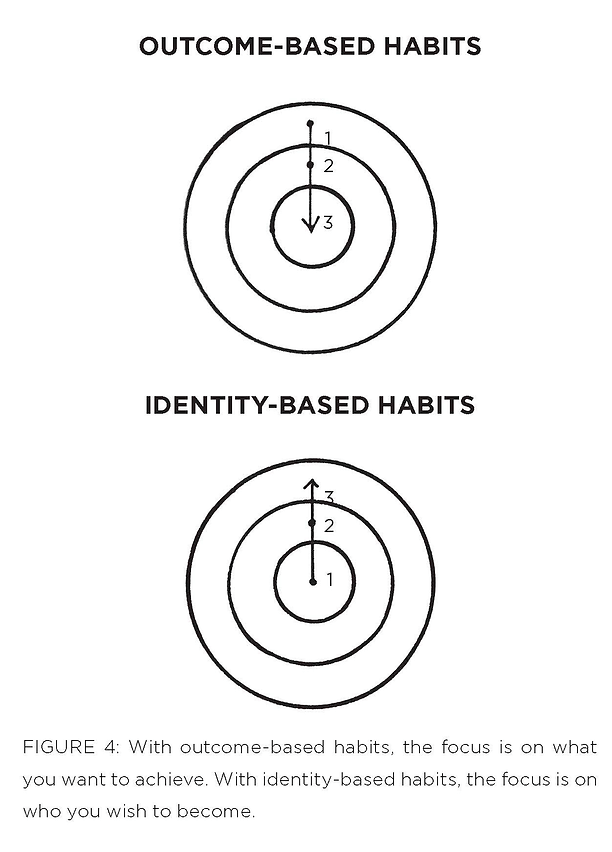
1. Identity-based habits vs Outcome-based habits

He discusses these via the ‘three layers of behaviour change’: outcomes, processes and identity.
As he explains, when people form habits they usually start with focusing on what they want to achieve (top right), leading to outcome-based habits.

However, as James writes: “The ultimate form of intrinsic motivation is when a habit becomes part of your identity. It’s one thing to say I’m the type of person who wants this. It’s something very different to say I’m the type of person who is this.”

He goes on: “The goal is not to read a book, the goal is to become a reader. The goal is not to run a marathon, the goal is to become a runner. The goal is not to learn an instrument, the goal is to become a musician.”

When I first stumbled upon this concept, it really resonated with me. And when I started implementing identity-based habits (bottom right) as opposed to outcome-based habits, this was a true turning point in making them consistent.

Be that person who does the thing. Don’t do the thing now and again and hope you’ll just become the person.

2. Habit-stacking

A simple concept but when outlined makes so much sense: do habits together, one after another, with new habits and existing habits. Big habits or small habits.
For example:
Big – Stretch > Exercise > Sauna. Small – get out of bed immediately when your alarm goes off > make your bed > clean your teeth + floss > shower > moisturise > brew a cup of tea > meditate whilst the tea is brewing > take your cup of tea and start the first task of the day. Or something like that.

The point is is that you can reinforce existing habits with other existing (or new) habits. And before you know it, you’ve already stacked lots of good habits with each other. Resulting in health and happiness!Unsurprisingly enough though, this also applies for Bad Habits, so be careful.

And whilst we’re on the subject of Ed Sheeran (no I’m not going to quote the song), there’s a great clip of him on a radio show online talking about how his habits lead to other things:
“If I have one beer, then I’m going to want another beer, and then I’m going to want a shot, and then I might want a cigarette, and then I might want a Big Mac… but with healthy shit, it’s if I drink water all day long it makes me feel great, and then if I feel great I might exercise, and if I exercise and feel great I’ll have a good night’s sleep, and if I have a good night’s sleep I’m more likely to want to get up early in the morning and do it all over again.”

Forget the song lyrics Ed, I think they could be the most profound words you’ve said or written.

3. Habit-tracking

Habit tracking changed my life, in an amazing way. I started doing it during my Dad’s health decline when I was spending a lot of time at home, when trying to maintain a routine of some sort, and adjusting to the change of location, access to the gym and various other factors. It helped me gain and maintain a very good degree of health/fitness and massively helped my emotional capability.

Habit-tracking holds you accountable because it’s literally in black and white (pending what colour pen you use, you child) as to what habits you’ve completed. It’s direct evidence of progress. It’s also a reward system because, let me tell you, it’s VERY satisfying when you build up a series of ticks consecutively! (Yes, this is genuinely what excites me nowadays.)

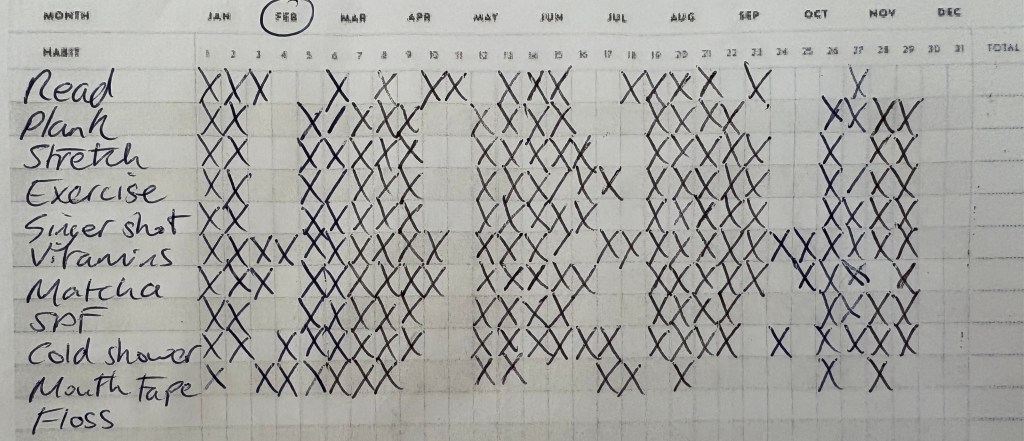
Here’s a previous photograph of a habit-tracking month gone by:

The eagle-eyed of you I’m sure have discovered that I have 0 motivation or discipline with flossing, and as a result, I couldn’t even manage 1 attempt this particular month… we’re all human.

Apart from that, it’s a very decent month I’d say.

‘Not breaking the chain’ is a great and very rewarding process that James talks about, as is the power of ‘never having 2 consecutive days off’.
Although admittedly I struggle with the latter at weekends…

SO if any of those 3 bits of information resonate with you like they did for me, I urge you to buy a copy and read Atomic Habits by James Clear. An excellent book and one that will give you 100000% (not accurate, but not far off) ROI.

Whilst writing this blog post, I stumbled upon this unpublished update report on my own habits (another sentence I never thought I’d write), found in the notes on my phone:
“So, 5 months after writing down (with a pen and paper, not a phone) my personal and professional short/medium/long-term goals and 3-4 months of habit tracking, I feel great physically and mentally great. Strong, but I prefer great. I’m happy. Despite grief, I really believe healthy habits and lifestyle choices can be a catalyst in helping to making you physically and mentally strong and healthy, which is directly linked to being happy in life.”

For me, this is [at the very least my own personal] proof of how habit-tracking can hold you accountable, massively help in maintaining discipline and motivation, but most importantly spawn those amazing results.
I won’t dwell on the grief part of that note – but I think it’s really helpful context for how I can still feel that good, if I habit-track, despite the shittiness of experiencing grieving.

CONFESSION…. !
I hold my hand up, I’m a total fucking hypocrite, because I don’t habit track at the moment. Maybe in future again though… BUT… I did it for quite a few years.
IMMEDIATE VALIDATION EXPLANATION: I haven’t habit-tracked for a good few months, the reason being – and I promise I’m not a hop off-on bandwagon guy – is that I feel as though the habits I used to track/stack are very well engrained into my routine and psyche these days, meaning I do most of them daily anyway. So although I’m not manually recording results, I still feel as though I am achieving maintaining habits. And I also wear a WHOOP now, so I pretty much track everything digitally. I use a custom plan where I have added my ‘behaviours’, and closely follow my logs of sleep, strain and recovery.

Wait a minute…

Am I still habit-tracking? Just in a different way?

Is my WHOOP in fact a glorified habit-tracker?

[REALISATION WHEN WRITING THIS]

UPDATED CONFESSION:

Despite not using pen and paper to track my habits, I still do habit-track. And I find a great tool to do this is WHOOP.

Side note: it’s been a game changer for my sleep. Categorically helping me to focus on and improve my restorative sleep levels. For more on sleep visit HERE.

I urge you to start forming habits. New ones around good existing ones, maybe lose one or two bad ones if you can, replace existing bad with good etc etc etc.

You might be thinking: Why though?
Fair point.

Results is why. Progress is why. Improvement is why.
Health is why. Happiness is why.

Back to Habits King James Clear one more time:
“Habits are the compound interest of self-improvement. The same way that money multiplies through compound interest, the effects of your habits multiply as you repeat them. They seem to make little difference on any given day and yet the impact they deliver over the months and years can be enormous. It is only when looking back two, five or perhaps ten years later that the value of good habits and the cost of bad ones becomes strikingly apparent.”

I think that’s the best thing to keep in mind about starting/maintaining habits – the bigger picture. And with consistency, results will happen. Guaranteed. Like actually guaranteed. And results will most likely be much quicker than 2 years. With wellness we’re talking weeks, even days. Just hold up your end of the bargain, and habits will get you results.

Hence, the pattern of my habits is always directly correlated to how I’m feeling at the time too – as in, the more habits I do, the better I feel. The healthier I am, the happier I am. Physically better, mentally better – in all aspects, there’s no catch. That’s because It’s Not A Coincidence*.
*the name of my future book, did I tell you?

Another great way of managing habits is via time-blocking. Literally blocking out windows of time, for different tasks, for various durations, throughout the day.

By no means essential but actually very useful. Especially if you have a freelance/not-consistent work calendar or non-typical routine, as in my case. I find it also helps with motivation, a LOT. And boring tasks. A LOT.

There’s one method which is 25 minute deep work/5 minute break – called The Pomodoro Technique – and I find this extremely effective. It’s enough time to get stuck into something, but short enough so that you don’t risk zoning out or wanting a break. I’m talking deep work. Deeeeeeeeep wooooooooork. No phones.

Wait what?
Yeah NO PHONES.

[Audible gasp from the young crowd]

Now if you’re Gen-Z DON’T PANIC. Life will (miraculously) go on. You will survive. And if you fall into this particular demographic (or hold similar traits), and NEED your actual phone to do actual work constantly for 25 minutes, get a separate work phone, or… a new job?Or failing that, GET A FUCKING LIFE?

Any other generation reading this though, The Pomodoro Technique (without phones) can be very effective.

As the psychiatrist Phil Stutz says, if you focus on your ‘Lifeforce’ – which is your Body, Relationships and Yourself – then every other thing you would love to have in your life will follow. And I believe prioritising habits can help you do that.

If you are reading this and are conscious that you want to improve your habits, or even just start doing some, because you want to be healthier and/or happier, I urge you to get start prioritising/forming them as soon as tomorrow.

It can be daunting starting a new routine and implementing new things, granted, but habits will hold you accountable and help you get there. Try it!
And before you know it… your body is in a better place, your mind is in a better place, and you feel better – scratch that, you’re healthier and happier. To be honest, that’s kind of how it happens. If you’re committed and follow through. Before you know it, everything gets easier. Generally. …Well, it doesn’t, but you get stronger. Try it. Especially in the tough times – despite my affair with hypocrisy during this post, I can at least vouch for that.

To quote our new friend Phil Stutz one more time, “there are 3 guarantees in life: pain, uncertainty, and constant work”. And surprise! Habits help navigate these entirely.

It’s Not A Coincidence*

*Still a name for my future book… although I can’t promise it will be as good as James Clear’s books or Ed Sheeran’s lyrics…

Written as part of The Wishing Wellness – visit HERE for more content on habits.
Matcha tea: a ceremony

First of all, the title is meant to be said like a rhyme.
Second of all, I want to not-humbly boast that I’ve been drinking matcha for YEARS. Much longer than the recent resurgence in society would suggest. So at 31 years of age, I’m proud to declare I’m not just a ‘bandwagon guy’ when it comes to the magical green powder. (That’s another tragic sentence I thought I’d never write…)
But the reason I’m writing about this is because I feel that I’ve categorically benefitted from drinking matcha tea – physically, mentally, spiritually – and I hope others can too.

So it’s because of this that I feel as though Matcha is worth advocating for, and is worth talking and writing about – and if these cobbled-together words help with that, my job is done – as with everything discussed on The Wishing Wellness.


I’m THAT guy known for offering matcha around the office at work – to pretty much anyone who wants some – first-timers, regulars, one-off’ers, those who have never heard of it, those who hate it. To the point of me trying to convince people it’s very much in their best interests to accept the offer. I do this whilst shamefully declaring that it will make everyone ‘happier and healthier’ – and then, if anyone is STILL interested (unlikely), I reel off as many benefits that I can think of, in the hope that that person will realise why this offer really is worth the uptake.

I’m also yet to charge anyone in the office – although I’m definitely £££’s out of pocket by now due to my generosity (insistence). But what those who decline my invitation don’t realise, is that not only am I offering a FREE hot drink, I’m offering them a free hot drink that is FULL to the brim with goodness, and absolutely no badness. So after the usual polite decline, I usually start my counter-offer with “Are you sure? You don’t want to be happy and healthier?” – by which point any hope of that person being convinced has totally disappeared, probably due to the patronising nature of such counter-offer. This is all an exaggeration of course. Or is it? (Come to the office for a FREE matcha and find out!)

‘The matcha offer’ is usually met with a vast range of replies – on a scale of delighted to disgusted. For my fellow green-people*, the interested, or sceptics (or disgusted-but-interested), I might actually go on to talk about benefits, if asked. Otherwise, there might be the odd exhilarating occasion when I get to watch someone try it for the first time – where they actually think they’re on an equivalent to the eating trial in I’m A Celeb – that’s always cute (and pitiful) to watch. Whichever camp you fall into though, I’m going to try to prove in the next few lines that matcha WILL make you happier and healthier.
*not a thing

SPOILER: Matcha WILL make you happier and healthier.

But first…

What actually is matcha tea?

Well, matcha tea is simply green tea, that’s been shaded and harvested. In fact, both matcha and green tea come from the Camellis Sinensis plant – and so does black tea, white tea, oolong tea – it’s just that they’re all processed differently, which results in different outcomes. A lot of it is to do with antioxidants – so when tea is picked, it ferments (oxidises/combines with oxygen), and then according to how that process is done, it changes colour/blackens, which in turn affects the types of antioxidants in it.

If you’re thinking: you’ve lost me at antioxidants: they basically contribute A LOT to overall health, aging, disease prevention, killing off unhealthy cells, the list goes on… Your body produces some naturally but dietary choices are crucial. And green tea/matcha has a TONNE of them.

So, matcha comes from the same leaf as the green tea plant – but crucially it is grown in the shade. This increases the chlorophyll content – hence the dark green colour. Of course there are lots of different types of matcha – but generally speaking, the darker, richer colour of green, the better quality the matcha. Hints of yellow or brown, you’re at the other end of the spectrum.
Matcha is also graded in terms of quality: ceremonial (the best), premium, or culinary – but there are various other grades/categories depending on provider – I drink a ‘daily’ matcha for example. I’d advise picking the type based on how you intend to consume it – if you can’t stand the taste, but want to cook with it, go for the culinary/lower-quality option. If you want to start drinking matcha for the first time, I’d advise maybe starting with a ‘daily’ or ‘traditional’ option as it’s usually a good middle-ground, before spending all your pennies on the premium stuff.
The grading can also be determined by when the leaves are picked – so if it’s from the ‘first harvest’ for instance, it’ll be better quality.

Now, THE KEY DIFFERENCE between Matcha and ‘standard’ tea, like the breakfast tea the UK consumes in abundance (understatement of the year) – is that matcha is processed using the ENTIRE LEAF. This is a BIG factor in why it contains so much more ‘stuff’ that is good for you – and why it provides SO much more benefits than your average cup of Joe.

So let’s talk benefits…

The biggest headline is that matcha contains LOADS of antioxidants. Like loads. In science talk: “high levels”. Put it this way – a comparably large amount, compared to things deemed to have tonnes of antioxidants in, such as blueberries. Some sources say 15-29x the amount of blueberries, but I wouldn’t be so scientifically vague, so we’ll stick to “high levels”. To quote Ian Beale from Eastenders, blueberries really “have got nothing left” when it comes to battling it out for antioxidant count against matcha. (That’s another sentence I also thought I’d never write).

Antioxidants are really important. Our bodies need them to defend ourselves against free radicals. You’d be forgiven for immediately thinking they’re happy-go-lucky hippies, but what they actually are very unwelcome bodily guests, in the form of molecules or atoms missing an electron. So what they do is try to steal other electrons from healthy cells, which can ultimately do lots of damage to proteins, DNA, and cell membranes. Over time this can lead to nasty outcomes like faster aging, skin conditions, heart conditions, and even cancer. Not all free radicals are evil though, we just need to keep them at a healthy number – and the antioxidants that matcha provoides helps to do that.

Some of the antioxidants you get when you drink matcha come from one of the main compounds found in green tea – catechins – which help lower blood pressure, tackle “bad” cholesterol levels, and generally help your heart a lot – whether that’s helping to prevent heart failure, regulating blood pressure, help with hypertension, or reduce the risk of blood clots and heart attacks. Catechins also help with inflammation, and that leads me on to… polyphenols…

One of the main missions of The Wishing Wellness is to promote longevity, and key compounds that helps us to have longevity are polyphenols – and there are a lot of them in matcha. Polyphenols are naturally occurring plant compounds, which have antioxidants, but also have anti-aging AND anti-inflammatory properties. The latter of which concerns protection against cell damage and inflammation. And just to emphasise, inflammation is a BIG one when it comes to your overall health… a big old factor in the world of arthritis, asthma, atherosclerosis, blindness, cancer, diabetes and potentially even autism and forms of mental illness. I highly encourage you to read more on inflammation generally. Or just go ask Dr Peter Attia or someone like that.

Matcha also contains lots of amino acids, namely L-theanine, which has been proven to alleviate anxiety and stress, and help with sleep. It also has a high mineral count (of different varieties) – which have SO many health benefits – including: improved insulin sensitivity; improved concentration and alertness; better circulation; promotion of cancer-fighting cells; and generally a whole array of things to do with immunity. There has been some evidence to show green tea can help you lose weight too. So put down the Ozempic you absolute IDIOT and go an exercise (no, seriously, put it down, you IDIOT). Plus other evidence suggests matcha can help: support bone health, slow down cognitive decline and protect against neurodegenerative conditions; enhance memory.

I said matcha WILL make you happy… well, this 2023 study researched matcha tea consumption and it’s anti-depressant effects on mice – it’s conclusion: “we showed for the first time that Matcha tea powder exerts its antidepressant-like effect only in stress-vulnerable C57BL/6J mice and that the activation states of the PFC-NAc-VTA circuit contribute to such effects.
So despite being a very small example, we have some concrete proof to show matcha really does provide antidepressant-like effects. Does this = happiness? Maybe not. Maybe. But I still find this remarkable.
And if we combine this with other matcha benefits, such as alleviating anxiety and stress, we’re well on our way to happiness.
And just to go back briefly to amino acids that matcha provides, such as L-theanine – these have been shown to increase the release of the ‘happy chemicals’ dopamine and serotonin in the brain, which leads to improvement in mood and positive thinking. Maybe now we’ve reached happiness?!

Now in order to get the benefits of matcha, it’s really important to sort yourself out with some proper matcha – don’t get it from a big high street brand as part of some sugary shite like an ‘Iced Lavender Matcha Latte’ – which contains about as much matcha as the screen you’re reading this off. Cynicism aside, the ‘matcha’ that most high street brands use is genuinely NOT matcha – more so a ‘green tea powder’ (sounds ominous right? It is.) mixed with sugar. And lots of other shit (not accurate). Just to put this into quality context, and validate my cynicism, there was a study done in recent years, that showed that there was 137x the amount of a certain antioxidant in one type of matcha tea, compared to a type of green tea Starbucks use that has the same antioxidant.
So don’t come flailing your completed loyalty card at me smiling as though you’re the personification of Matcha itself, because you’re not – you’ve been sold a lie. Get yourself some of the pure, proper stuff! This also goes for those drinking green tea from commercial green tea bags – that’s like saying you’re eating good chicken when eating chicken nuggets, which clocks in at around 45% actual chicken – I would guess green tea bags have even less proportions compared to whole-leaf matcha servings. So if you’re smashing in multiple green tea Twinings bags every day thinking you’re the shit, think again you loser. Sorry bit harsh, but you are a loser, because you’re losing out on all of that extra goodness you can have with the real thing. As with high street matcha.

But one of, if not arguably the biggest draw for me when it comes to drinking matcha tea – and other types of loose leaf tea – is the ceremony that comes with it. A tea ceremony is more than just dipping a bag in a cup for a few minutes and adding extras, whilst you distract yourself with some other activity. It’s a mindful moment, a focus on the preparation, serving and drinking tea – a ritual that is seen to promote mindfulness and wellbeing.

Matcha (and lots of types of loose leaf tea) originated in China, but it’s primarily known as a Japanese tea. There is an ancient saying in Japan: “Wabi-Sabi” – which means finding beauty in imperfection and simplicity. And a tea ceremony embodies exactly the latter. It really isn’t just about the health benefits that come with matcha, or what some describe as the glorious taste of ‘grass’ – it’s also about mindfulness, and the ritual of the ‘ceremony’. It’s a (daily) moment to connect with yourself, be at one, be present – both in the preparation and consumption. Matcha has a long history in Zen Buddhism – and the process of making and drinking matcha tea is seen as meditative process.

So, how can I get started with this bat-shit Buddhist bollocks? I hear you ask…

… excuse ME. What I think you mean is:
What do I need to get started with a matcha ceremony?

Cue 3 things typically used in a matcha/tea ceremony: ceremonial bowl, bamboo whisk and a wooden measuring ‘spoon’ (it’s not really a spoon, it’s more like a tiny wooden measurer).
Measure your matcha according to instructions, ensure the water is the correct tempature (approx. 80c), and whisk away. Some advice encourages you to whisk in your matcha using an ‘M’ motion – seems a little too poetic for me, although I must say it does work. No lumps in sight, ever.

I highly advise you to make your matcha this way. Have a ceremony. Take a moment for you, and take time to focus on preparing and drinking it. Whatever is going on in your life on that day, stresses, demands, responsibilities, take a moment to prioritise you and your matcha ceremony. You won’t regret it. Like the phrase I coined for a cold shower – Microcosm of Mindfulness – I think the same applies to a matcha ceremony. (For more on cold showers visit here).

Although I do understand that life is busy, it probably isn’t a priority for you to carve out that time right now – so if you’re on the go, or at work, and you don’t have time for a ceremony, here’s how you can prepare/consume matcha via ‘western brewing’:
– Fill a cup with 80% boiling water, 20% cold water.
– Get half a teaspoon of (proper) matcha
– Stir in
– Drink
It’s as simple as that.
Granted you may compromise some mental and spiritual benefits with this process, but you’ll still be consuming all of that goodness previously discussed.

Oh, and why 80/20 water? Because you don’t want to burn the leaves! You fool of a Took.

Lastly let’s talk caffeine and matcha: expect a gorgeous slow-release caffeine release that escorts you like an Uber LUXE to the afternoon. That’s pretty much it. Unlike coffee which is fast-release and essentially ramps your caffeine up intensely, and can make you feel light-headed or tingly, matcha is the opposite. There won’t be any jitters or shakes, instead it’s calming, tranquil. I genuinely feel revitalised when I drink it.
Basically, if you visualise a really shallow upside down U across the timespan – that’s what matcha’s caffeine release is like. With coffee it’s like a really steep and narrow upside U.
This means that with matcha, unlike coffee, you will not ‘crash’ and need more caffeine to sustain you. And although less harsh uptake, it lasts longer. It also means people who wake up NEEDING caffeine to feel normal, or those who NEED ANOTHER COFFEE after their last crash, won’t experience this feeling. Pretty great, right?

(If you do NEED caffeine, and can’t fathom the idea of not having any, you’re probably caffeine-dependent and should consider realigning your relationship with it. For more Wishing Wellness content on caffeine and how it affects your sleep, visit here).

A friend asked me recently does matcha cause dehydration? The answer is no – the only thing in matcha that can lead to dehydration (but generally doesn’t) is caffeine – of which there is much less than in coffee.

That’s pretty much it for now, for this instalment of The Wishing Wellness on matcha. I hope you have been inspired to start or continue your matcha journey. Since matcha has been a constant in my life, I really believe it has helped me grow physically, mentally and spiritually – the health benefits speak for themselves, and I can categorically say I find great value in my daily matcha ceremony. When I drink matcha in the morning I don’t feel the need to keep making cups of tea each hour. I used to work in breakfast radio and get up at 4am every day, and I would consume anything between 3-6 double-bagged breakfast teas before 11am. Since consuming matcha I only need one AND I feel better for it. I don’t feel jittery whatsoever, and very much more calm in comparison. I do believe it’s had a hugely positive effect on my anxiety as a whole.

Let me admit, I don’t drink coffee. So I can’t compare a matcha ceremony to the coffee process. But I’m sure mentally/spiritually it may have a similar impact, if done like a ritual. Which is great.
What I am sure of though, is that if you start to swap your coffee for matcha, you won’t crash in the afternoon, and you certainly won’t be craving the next one.

Finally, it’s worth emphasising that matcha is green tea. And drinking non-matcha green tea will give you lots of the same benefits (providing it’s loose leaf and not the shitty types of teabag tea we discussed). So if you don’t like matcha at all, maybe start with that. Either way, be sure to start/continue your matcha journey with the PROPER STUFF – and if you’re in the habit of consuming some sugary high street rubbish that is disguising itself as PROPER matcha, get rid, and get ordering from a reputable source. Or get your tickets booked to visit a cultivar in Asia. One of the two.

PS. if you do start having matcha ceremonies and you think those are exciting… wait until you enter the world of Gong Fu brewing!

… What in the matcha is Gong Fu? Well, that’s for another day.


Written as part of The Wishing Wellness – visit here for more content on matcha.

Cold Exposure: A Microcosm of Mindfulness

Even if you were born yesterday, you’re probably already bored to death of how many people/places/communities encourage you to have a cold shower, ice bath, or go cold water swimming. It is pretty relentless. BUT… it is for good reason, and it’s not a fad. At least it definitely shouldn’t be. And if you do end up joining the ever-growing, all-knowing, self-righteous, over-enthusiastic army of cold goers, you’ll most likely realise why it should indeed not be just a fad – that’s at least if you stick with it.

And that’s the aim of this post to be fair – to take a quick dip into the science of cold exposure, via the words of an ever-growing, all-knowing, self-righteous, over-enthusiastic cold goer.

Granted it’s not an essential practice, but it is a wonderful wellness tool you can use to experience a whole host of physical, mental AND emotional benefits – and the best part about it – presuming you have access to a shower/bath/lake/river – is that all of those benefits are FREE.

Every day, you, yes YOU, have a choice to turn that hot, steamy shower dial down to as cold as it can go, and experience the benefits. If you don’t do it, you don’t get the benefits, simple. But hopefully some of the following information may inform your choice to make it happen, to stop being a whiney little bottle job, and to take action and reap those (free) rewards.

The rewards being: boosting your immune system, improving circulation, reducing stress, kick starting metabolism, improving cardiovascular health and insulin resistance, reducing pain and inflammation, improving sleep, reducing tensions, fatigues and negative moods, and weight loss – some studies have even shown cold exposure can help relieve depression. And last of all, you can literally get ‘high’ off your own brain chemicals – yes you read that right. Got your attention didn’t it, you absolute degenerate. More on that later…

First of all though, for any sceptics or doubters as to if it those benefits actually take place… well, IT’S JUST SCIENCE okay – I won’t go into the exact studies concerning the above benefits now, but have a little read/research if you want clarity. Consider this a whistle-stop tour, not a scientific essay.

In short though, when you’re experiencing the cold, your body initiates vasoconstriction, meaning the blood vessels narrow, enhancing circulation, improving blood pressure, to ultimately reducing the workload of your heart. Vasoconstriction helps to conserve heat and redirect the blood flow to vital organs and tissues more efficiently, delivering lots more oxygen and nutrients than what it would do otherwise. 

When cold exposure ends, vasodilation takes place, restoring the usual blood flow with enhanced overall circulation.

In turn, this contributes to a reduced heart rate which leads to better heart function, better cardiovascular health and fitness, as well as a stronger immune system.

IF you can manage 11 minutes or more a week, this amount of repetitive exposure to cold water can start to reduce the amount of unhealthy body fat, converting it to metabolically active brown adipose tissue. And cold water exposure has been seen to increase the amount of a hormone called ‘adiponectin’, which is made by adipose tissue. This hormone is important in preventing insulin resistance, in which the muscles, fat, and liver become less responsive to insulin.

However the biggest testament to the science is Wim Hof, ‘The Ice Man’, who has been proving scientists wrong and re-writing the script for what cold exposure does for the last 4 decades.

What Wim Hof has achieved was long viewed as (scientifically) impossible. During a study in 2011, he showed that by using his method (cold exposure, breathing, mindfulness), he was able to voluntarily influence his autonomic nervous system – the system responsible for controlling your body’s unconscious processes, the things that happen without you thinking about them, such as breathing and your heart beating. What madness. Fuck you outdated science. 

And if you want more non-clinical examples to demonstrate how capable he’s proven the human body/mind to be, well… he’s got [30] Guinness World Records for: running a half marathon above the Arctic Circle while barefoot and wearing only shorts; swimming underneath a thick later of ice for more than 200+ feet; standing in packed ice for hours WITHOUT HIS CORE BODY TEMPERATURE DROPPING; and summiting the world’s highest mountains wearing only shorts.

So trust me – and trust Wim – you really are capable of withstanding a 30 second ‘cold’ shower. I say ‘cold’ because it’s really not as cold as the Arctic Circle. The point is, you, like him, have a body and mind that is biologically built in the same way, and is the result of millions of years of evolution. And with that body and mind you CAN do extraordinary things. You CAN withstand the stress of situation. And that’s what exposing yourself to the cold is, stress. The difference though is when you consciously expose yourself to voluntary stress, it can have amazing benefits.

So let’s talk stress… 

How I find it really helpful to frame the cold shower or swimming/ice bath experience whilst I’m experiencing it, is this:

“Nothing in my day is going to be as stressful as this moment right now – so if I can get through this, I can get through anything that comes my way today.” 

(In the form of personal or professional stress, or whatever things you have to tackle in your day are).

Cold water exposure is a type of hormesis, which is when we put voluntary, healthy stress on the body. In exercise this could be a HIIT workout, or for digestion, fasting could be an example. With the right dosages, it’s short-term stress on the body, which in turn (and time) results in hugely positive effects. It has to be healthy stress though, not just any old stress. Don’t come up with some novel idea which is is clearly negative stress and expect to bounce back stronger…

Ultimately, what you’re aiming for with cold exposure is to shock the body enough so that it’s stressful and all you can think about is “THIS IS FUCKING COLD”, but be able to withstand it without feeling unsafe, until you’ve done your time. 

What’s happening in this (voluntarily) stressful moment, is that you’re purposely triggering your body’s fight or flight response, via stimulating the sympathetic nervous system. During this response, your body releases the stress hormones cortisol and adrenaline, as well as norepinephrine – and you’re exposing your nervous system to small amounts of these stress hormones, which in turn means that you can build your tolerance to stress over time.

So when you find yourself in a stressful situation away from the cold exposure, say during an uncomfortable work meeting, your body can naturally react much better to whatever the stressful stimulus is, and you can manage your body’s reaction to deal with the situation better than you did before – channeling your response like you did in the cold.

Right that’s enough about stress, let’s talk about happiness!

I vividly remember when I first started having cold showers, one time I experienced this euphoric moment out of nowhere, where like turning a light switch on, I instantly became so happy and laughed out loud, and maybe even ‘whooped’… At the time I couldn’t explain it, but now I know it’s because cold exposure stimulates the release of brain chemicals and neurotransmitters – such as dopamine and endorphins – which act as natural painkillers and mood boosters, leading to increased energy, better mental clarity and reducing stress, AND guess what… feelings of EUPHORIA! 

My favourite stat around this is:

When you expose yourself to the cold for 30 seconds or more, you can experience an increase of up to 2.5x the levels of dopamine, for 4-6 HOURS! Let me repeat: FOUR TO SIX HOURS. Mental. Now this is the fun bit of the stat – and it concerns cocaine… (welcome back to the conversation degenerates):

People who indulge in a line of cocaine experience 2.5x levels of dopamine… wait for it… for… 9 MINUTES. NINE MINUTES. And then, they need more to keep up that high. 

So now you know that if you choose cocaine over a cold shower, you really are fucking stupid. (Although it’s not exactly the same ‘high’ – the cold is more slow-release over a longer period of time – but you get the point.)

Like anything I write about, I’m an advocate for, and at the risk at sounding like a totally out-of-touch plonker, I do feel ‘part proof’ that these wellness things/techniques really do work. And I can categorically say that for the last 3 years regular cold exposure has contributed to me having more energy when I need it, better clarity and a true ‘reset’ in the morning if I need it. Sometimes I have my best ideas in the cold, it’s also a SECOND-TO-NONE HANGOVER CURE, and this might sound extreme but it really has been a key component to helping me dealing with my own grief. That I do believe.

I also think that if the benefits of cold exposure were offered in a tablet form which you took regularly, it would no doubt be the best selling drug on the planet. The crazy thing is you can have these benefits for free, just by doing it, and not taking any drug. “Get in, get on, get out” is a phrase I use regularly and think appropriate for several experiences on this planet, and it’s very relevant for this particular one. 

So stop being a little whiney (warm) wet wipe, batten down your ego, and make it happen. The little voice in your head telling you not to do it is actually there for a reason – to protect you from actually danger – but in this case, tell it to piss off. Override it, turn the dial, and withstand the cold. 

What also really helps me in the cold shower, is to breathe – and when I exhale, I use only my nose – which means I can only exhale so fast, which in turns slows my breathing and helps combats the stress. Plus, over time, your body and mind become more resilient meaning you can withstand the cold for longer – it gets easier, but that’s because you get stronger. 

Generally the most accessible way to benefit from cold exposure is the shower – but an ice bath will maximise the effects even more. Cold water/wild swimming also packs the same, if not a very similar punch. Either way, if you’re reading this there shouldn’t be any reason you can’t start your cold water journey as soon as, well, NOW – or at least tomorrow morning…

Start at 15 seconds, then gradually increase your exposure all the way until you can withstand 2 minutes or more.

If you find you’re really struggling – maybe consider trying Wim Hof’s breathing techniques (or similar) to help prepare your body before embarking on your cold feat. That’s also something I’ll write about in the future which has great benefits in isolation, let alone alongside cold exposure. Put it this way, the first time I did it, I held my breath for over 3 minutes!

All it takes for you to experience the countless benefits from cold exposure, is to turn down that dial at the end of your shower. So, what are you waiting for?


PS. This post is called ‘A Microcosm of Mindfulness’ because that’s the phrase I’ve coined for a cold shower. I think the experience forces you to be mindful in a way – because all you can think about (generally, and at least when new to cold exposure) is “this is fucking cold”. And you can’t think of anything else. Therefore you’re essentially forcing your mind to not think about anything else, and shut off all of the noise from your life/the outside world – and in turn having one central thought. Which relates to mindfulness, because during meditation you can use the breath as the ‘one thing’ to pull your mind back to when you get distracted. In this case, it’s the cold.


Written as part of The Wishing Wellness – visit here for more content on sleep.

The Sleep Conundrum

Why is it that we spend 1/3 of our entire lives completely switched off from the world? Well, I guess because we’ve evolved and no longer have the worry of being royally fucked by a dinosaur during the night? Because dangers like this and further equivalents still existed, we’d be the most stupid species on the planet to be in this unaware, unresponsive, and unprotected state we call sleep, wouldn’t we?

Seriously though, we do spend 1/3 of our entire lives completely switched off from the world because we really need to. That is, so we can rest and recover via sleep, in order to experience everything life has to offer and live life to the fullest – which requires all of our systems and senses firing on all cylinders, which can only recalibrate during… you guessed it… sleep.

Perception, logic, memory, decision, functionality, creativity – the list goes on – these things can only operate optimally with sufficient sleep, no matter who you are. If you’re one of those people who ‘only sleeps 4 hours a night and functions fine’, well, bravo, BUT, you’re categorically not performing as optimally as you could be. 

And just to re-emphasise, we really are a stupid species, because we’re in fact the ONLY species to purposely deprive ourselves of sleep, without any legitimate gain. Madness. And you can probably guess that in doing so, we miss out on tonnes of benefits and maintenance that our brains and bodies require, which only a full night’s sleep can provide. So next time you think you’re ‘cool’ because you’ve decided to do an all-nighter (apart from if the odd indulgence of course…) but especially for no good reason, think again you absolute melt. Quite simply, the shorter you sleep, the shorter you live.

As Sleep King Matthew Walker says (who I’ll refer to several times in this passage): “sleep is the single most effective thing we can do to reset our brain and body health each day”. In doing that, we are enabled to make the most out of our waking hours. More generally, life. As we know, wellness should be the practice of contributing to an amazing healthspan, not just a lifespan. And without good sleep hygiene, a great healthspan is impossible. With the caveat of enjoying life now and again and a few late night boogies TILL THE BREAK OF DAWN*, it’s quite important we do have quality sleep, regularly and sufficiently, so we can achieve that healthspan. And making sleep a priority, ultimately leading to better sleep, begins with an awareness of what sleep actually is and a little understanding about how exactly your body does sleep, in order for you to align your sleep routine with your body’s natural processes. 

*One of my favourite movie quotes from ‘Project X’… it also reminds me of Dawn, the beautiful mother of one of my best friends Ham (Adam). I don’t know why, but for some reason he used to get rather irritated by us saying “we can’t wait to wake up at the crack of dawn tomorrow”..

So why should we actually sleep? Well, in short, sleeping recalibrates your brain – as said, learning, memory, logic, choices, more broadly social and psychological skills all get reinforced. For your body: your appetite is regulated, the immune system is bolstered, insulin and glucose is balanced, your cardiovascular system and blood pressure rests, and your gut upholds a flourishing microbiome. Ooh la la.

So go to sleep okay. Y0u won’t regret it. Just don’t sleep too much though.

As at a certain point, crossing the threshold of too much sleep, can have a negative effect which can result in a range of symptoms. But broadly speaking, between 7-9 hours is the sweet spot. 

So. To the technicals.

There are TWO main factors that determine our body’s need for sleep: 

  1. Circadian Rhythm
  2. Sleep Pressure

1.

Your circadian rhythm is an internal 24-hour clock that sits deep in your brain – for the nerds, it’s in the suprachiasmatic nucleus. It regulates wakefulness and sleep through a variety of methods: regulating body temperature, timed preferences with the metabolic rate, urine release and hormone release. The latter of which concerns the hormone called melatonin, which you may have heard of.

Melatonin is the “vampire hormone” released at night (nerds: by the pineal gland), usually around dusk. “It provides the official instruction to commence the event of sleep, but DOES NOT PARTAKE in the sleep race itself” (quote sleep king Matthew Walker). What a twisted little satanic dictator hormone eh?

Your circadian rhythm is affected by our exposure to daylight/light and the intake of food, and uses both as information. I don’t feel like it’s my job to tell you to stop staring at the bright LED lights of all-consuming Tik Tok before trying to sleep, nor smash a cookie in seconds before closing your eyes, that’s your choice. But hopefully this information highlights why it’s preferable to pay attention to your circadian rhythm and how you can affect it, that is if you seek quality sleep.

2.

Sleep pressure is essentially a chemical barometer that continuously registers the amount of time we’re awake. It’s caused by build-up of the brain chemical adenosine, which in turn uses a dual-action mechanism to turn down the ‘volume’ of wake-promoting brain regions and turn up the dial for sleep-promoting regions.

Adenosine levels/the chemical barometer naturally builds up during the day when we’re awake, so by the time we’re ready for bed, it’s at a high level and ready to be cleared via sleep. Things like exercise and diet also contribute to adenosine levels, hence why it’s always a good idea to have good wellness practices – not a coincidence as to why you sleep better after a good workout.

There is one DRUG that has a huge impact on sleep, tiredness and adenosine though… and I’ve used the word ‘drug’, because that’s what it is. It’s called… caffeine. 

And if you’re a coffee loving hipster, – now is the time.

Sleep, is affected by caffeine, simple. Whether you do think it does, or not, it does, you coffee-loving hipster, flailing around with your little cafetiere grasping an overpriced bag of beans from Columbia, eagerly waiting to defend your night time addiction for caffeine. 

Maybe you feel as though it really doesn’t affect you, but it will categorically disrupt your sleep, and will end up reducing the functionality of your body/brain due to not getting enough sleep, or sufficient quality sleep, if you consume it too close to going to sleep.

I repeat. Caffeine is a legal drug. Sugar is a legal drug. Both contribute to making sleep worse. But let’s stick to caffeine for now, because I can’t handle the thought of sugar (and other ‘drugs’) effects on sleep as well, whilst I type this, ironically, past my bedtime. 

I quote the Sleep King again: “consumption of caffeine represents one of the longest and largest unsupervised drug studies ever conducted on the human race … perhaps rivalled only by alcohol … and it continues to this day.” 

He also asks the reader “Can you function optimally without caffeine before noon? If no, likely you are self-medicating your state of chronic sleep depravation.” Read that again. Mental right? He’s not saying, never have a cup of tea or coffee in the morning, more so, if you cannot do that without having a negative reaction or not being able to function properly, then you need to sleep – and to not rely on caffeine. And in the process, more sleep and less caffeine will help the relationship you have with caffeine. It’s quite self-fulfilling isn’t it.

THEN you can enjoy the true benefit of caffeine (when you’ve regulated it better), without the negative effects of addiction/reliance. Whether that’s coffee, or tea, or matcha, or whatever.

I love lots of different types of tea, but particularly matcha because of it’s slow-release caffeine that unlike coffee doesn’t spike, it stays at a lower but more sustained level throughout the day, preventing a ‘crash’.
(For more content on Matcha, visit HERE)

Coffee’s caffeine peaks after around 30 minutes, but has a half-life (which is used to measure a drug’s efficacy) – so if you had a coffee at say 4pm, 50% or more could still be active in your chubby little face (jokes) at 10pm.

SO, as said:

There are two main factors that determine our body’s need for sleep: 

  1. Circadian Rhythm
  2. Sleep Pressure

BUT, they do not communicate with each other, they are separate systems. Separate systems, that do however usually align with one another – and are informed by each other. Clear as mud right.

So in an attempt to see through that mud, A VERY EXCITING equation could look like this:

Urge to be awake = high wake drive (circadian rhythm) + low sleep pressure (low adenosine)

Urge to sleep = low wake drive (circadian rhythm) + high sleep pressure (high adenosine)

(You will have noticed we’ve been joined again by the second bloody satanic little dictator hormone, adenosine.)

And here’s another VERY EXCITING FOLLOW-UP equation:

Getting through an all-nighter (or having ‘second winds’ etc.) = high/upward wake drive (circadian rhythm) + high sleep pressure (high adenosine). 

So despite being very tired, your urge to sleep won’t be quite as high as when your circadian rhythm and your sleep pressure align like with above. What is actually happening is that despite your sleep pressure/adenosine levels remaining high, your circadian has cycled back around to being in the awake state, generating all of the bodily ‘things’ (like hormones being released) that come with that – hence why you feel more awake and are able to get a ‘second wind’.

And here’s ONE MORE VERY EXCITING FACT (not equation) about circadian rhythms – they change/shift throughout our lives, as we age.

So if you’re a parent, asking a teenager to go to bed and expect them to fall asleep by 10pm, it is the circadian equivalent of asking an adult to go to sleep at 7pm or 8pm. And asking them to wake up at 7am, is the circadian equivalent of asking an adult to wake up at 4am or 5am. So Mum or Dad reading this… back, the FUCK off and let your kids party and keep you up until at least midnight until when their circadian rhythms have slowed down again. Or maybe not quite that, but you get the point..

I’m not blaming parents for enforcing sleep at this earlier times, societal norms such as the ways schools’ timings operate don’t help of course. Ultimately for reasons concerning optimum sleep, these early times are something which should change in the future to accommodate the future generations’ sleep and brain development.

Question? Yes?

When are you technically asleep?

Well…

Your Thalamus is your ‘sensory gate of the brain’. This usually sends sensory signals to the cortex. But when the Thalamus imposes a sensory blackout in the brain during sleep, it prevents those signals reaching the cortex. This means your body is no longer consciously aware of the information broadcasts being sent from your outer sense organs – your brain has lost waking contact with the outside world. BOOM, straight from your toes to your ugly little face, you are asleep. 

Moving on to more really bloody fascinating sleep things – hardcore shit, like, dream sleep…

There are 2 TYPES OF SLEEP: NREM and REM (Non-Rapid Eye Movement + Rapid Eye Movement).

There are 4 stages of NREM – 1, 2, 3, 4 – increasing in ‘depth’. This is deep sleep.

REM is ‘dream sleep’ – when our brain activity is ALMOST IDENTICAL to when we are awake!

Both NREM and REM sleep ‘battle’ for brain domination during the night, and each tends to reoccur every 60-90 minutes. Typically, NREM sleeps dominates the early part of our sleep, while REM dominates the latter part.

NREM generates slow, synchronised brainwaves. REM generates fast, non-synced brainwaves – similar to when we’re awake.

This is probably my favourite fact about sleep (Christ alive I never thought I’d write that…) – but it’s FASCINATING… and it’s this:

During REM sleep, our brain can be 30% MORE ACTIVE than when we are awake. 

Yes you read that right. But read it again. 

Mental right?! Or is it just me? … Just me? Okay, great. Anyway.

Sleep King MW depicts the difference between REM and NREM sleep really well: imagine there’s a microphone dangling in the middle of a huge crowded stadium – when we’re in REM sleep, it’s like all of the individual supporters (in this case brain neurons) are chanting completely different things at different times, and the microphone picks up this cacophony of sounds, essentially frenetic brain activity. Compared with NREM sleep, deep sleep, where instead, all of the crowd is chanting in unison – meaning our brainwaves are slower and much more synchronised. The deeper sleep we’re in, the slower and more synchronised the brainwaves are.

Deep/NREM sleep (stages 3 & 4) – means that more distant parts of the brain can connect, and the brain collaborates better together. One benefit of this is a ‘file transfer’ process, where things like memories, learnings and skills get transferred from the short-term storage site of the hippocampus, to the longer-term storage destination which is the cortex – neocortex for the nerds. This process happens every night!

It can even happen during naps, if they contain enough NREM sleep.

This also explains why sometimes we are better at things when we ‘sleep on it’! By sleeping, it’s pretty much like we ‘gain access’ to a better overall understanding of these things – i.e the next day waking up and something ‘clicks’ and we’re better – like mastering a football trick, or a certain rhythm when playing a musical instrument.

REM sleep is greatest, when the brain is undergoing it’s greatest construction. Another great analogy from the Sleep King is this: think of REM sleep as an internet service provider, that goes round each neighbourhoods (in this case regions of your brains), and provides fibre optic to each of them, servicing and improving them each night.

Oh, and not to alarm you, but during REM sleep, you are completely paralysed. Apart from your eyes (hence Rapid Eye Movement). No biggie. So again, thank fuck dinosaurs aren’t here anymore, because I doubt we’d have been able to kill them with just our eyes moving, whilst our eyelids are shut… However, our bodies aren’t THAT stupid to do this with no benefit – we’re actually paralysed so our minds can dream safely, without actually acting out our dream experience!

In terms of benefits, REM sleep is essential for emotional and mental health, including things like rationality, sanity. It’s also crucial for problem-solving and creativity (which also applies to NREM sleep) – again, ‘sleep on it!’ Plus, REM sleep is the only time that our physiological response to stress and acute anxiety is shut off – via Norepinephrine, also called noradrenaline (both a neurotransmitter and a hormone) not being produced. 

And let’s face it, we’d all love zero stress in our lives… well, this is the exact time to experience it!

This leads me to another EXCITING equation:

A balanced night of NREM + REM sleep = better rationality, more emotional control, improved memory storage, consolidated learning, clearer logic.

To make it clear you need both adequate NREM and REM sleep to indulge in the whole host of benefits each provide. If you get up extra early, say for a flight, you might miss out on a percentage of the benefits, concerning either type of sleep. Just know that these benefits cannot be magically brought back when you miss a night’s sleep – when the opportunity has gone each night, no matter how much you sleep the next night, that day’s benefits have gone. 

Two more things before I nod off (hopefully you haven’t yet)…

1. SOME PEOPLE CAN CONTROL THEIR DREAMS! LUCID DREAMING IS A THING AND IT’S CRAZY!

Studies using MRI scans have proven it. I’ll let you do your own research/discovery in to the exact examples, but the headline is this: science has objectively proven that lucid dreamers can control when and what they dream, while they are dreaming. I’ll say it again, that is mental (literally).

2. Mouth taping will do wonders for your sleep. No it’s not some sort of bondage or fetish you dirty-minded individual. It ensures you nose-breathe entirely throughout the night which has a whole host of benefits, like stopping sleep apnea, which can be a major problem if not treated. It’s a whole other world of wellness I’m fascinated by and I will for sure write about it soon, but wanted to quickly mention.

So there we go – we’ve come to the end of our little foray into sleep. Hopefully it’s been educational and helpful. Hopefully you are still awake. 

Matthew Walker really is the sleep king, he’s brought a lot of this consciousness around sleep into the modern world. All credit to his and others research, data and examples. If you’ve enjoyed reading this I urge you to get his book ‘Why We Sleep’. Other sleep experts you can check out include: Dr. Charlene Gamaldo, Dr. Clete Kushida, and Dr. Michael J Breus.

As said, when it comes to wellness I don’t want to advise on what you should be doing with your life/health practices, I want to outline the information that helps you inform your decisions when acting on them.

We’re all going to die. But you really can’t ‘sleep when you’re dead’ – nor reap the vast benefits of sleep – so you might as well make the most of it now. Because in turn that will contribute to a better life, increased health, increased happiness.

From my perspective:

The Sleep Conundrum = learning to find a healthy balance of moderating your sleep, so you can function optimally and consistently throughout life, but knowing when to sacrifice it for a bloody good time or life experience. 

Or maybe you have another way of putting it?

—-

Written as part of The Wishing Wellness – visit here for more content on sleep.